Buying a condo in Austin is nothing like buying a house – and if you treat the inspection process the same way, you’ll likely miss the issues that matter most. A standard home inspection covers the walls and systems inside your unit. What it won’t tell you is whether the HOA is sitting on a financial time bomb, whether the building has undisclosed litigation pending, or whether a special assessment for $15,000 is about to hit your account thirty days after closing.
That’s the part most buyers skip. And that’s exactly where the real risk lives.
A thorough condo inspection checklist has two layers: the physical inspection of your unit and the shared building systems, and the document inspection of the legal and financial records that govern how the entire property is run. Both matter. One without the other leaves you exposed.
This guide walks through what to check, what to ask for, and what red flags should stop you in your tracks – or at minimum, send you to an attorney before you sign anything.
Why Condo Inspections Are More Involved Than House Inspections
When you buy a single-family home, the property you inspect is largely the property you own. The roof, foundation, electrical, plumbing – it all belongs to you. When something breaks, you fix it.
A condo is different. You own your unit. But you also own a share of the common areas – the roof, the elevators, the parking structure, the pool, the hallways. And those shared assets are managed by a homeowners association that may or may not be doing its job well.
That creates a layer of inspection complexity that most buyers don’t anticipate. You’re not just evaluating a unit. You’re evaluating an organization – its finances, its governance, its pending legal problems, and its plan (or lack thereof) for future expenses.
Austin’s condo market has grown significantly over the past decade, and that growth has produced buildings at very different stages of maintenance. Some are well-managed with healthy reserves. Others are running on deferred maintenance and financial fumes. The inspection process is how you tell the difference.
Section 1: Physical Inspection Checklist
Start here. Before you dig into documents, you need to know the physical condition of what you’re buying. Your licensed inspector will cover most of this, but it helps to know what they’re looking for – and where condos present unique challenges.
Inside Your Unit
- HVAC system: Confirm the unit has its own HVAC or verify the terms of shared system access. Check age, filter condition, and whether maintenance records are available.
- Plumbing fixtures and water pressure: Run all faucets and showers. Look under sinks for signs of past leaks or active moisture.
- Electrical panel and outlets: Verify the panel is properly labeled and up to code. Test GFCI outlets in bathrooms and kitchen.
- Windows and sliding doors: Check seals for fogging (seal failure), operation of locks and hardware, and any signs of water intrusion around frames.
- Flooring and walls: Look for staining, buckling, or soft spots that suggest moisture from above or beside the unit.
- Water heater: Check age and condition. In condos, water heaters are often located in closets – look for rust or corrosion at connections.
- Appliances: Test all included appliances and confirm what transfers with the sale.
- Ventilation: Bathroom and kitchen exhaust fans should vent to the exterior, not into a shared attic or wall cavity.
Shared Systems and Common Areas
Your inspector may have limited access to shared systems, but ask specifically about the following:
- Roof condition: Age, last replacement, any known leaks reported by the association
- Elevator service records: If applicable – look for inspection certificates and recent maintenance history
- Parking structure: Any visible cracking, drainage issues, or deferred maintenance
- Pool and amenities: Functioning equipment, recent inspections, compliance with health department requirements
- Exterior building envelope: Stucco, siding, or masonry condition – water intrusion at the envelope is one of the most expensive problems in mid-rise and high-rise condos
- Common plumbing stacks: In older buildings, ask whether the main stacks have been relined or replaced
One thing buyers often overlook: noise. Walk the unit at different times of day if possible. Listen for sounds from adjacent units, hallways, and parking areas. Noise transmission in condos varies enormously by construction type and building age, and it’s the kind of thing you can only evaluate in person.
Section 2: Document Inspection Checklist – The Legal Due Diligence Most Buyers Skip
This is where condo buyers separate themselves. The physical inspection tells you about the unit. The document inspection tells you about everything else – and in many cases, it’s the documents that determine whether the purchase is a good decision or a costly mistake.
Under Texas law, sellers are required to provide certain documents as part of the condominium resale package. We’ll cover the legal specifics in Section 5, but regardless of what’s legally required, there are records you should request and review before closing.
HOA Financial Documents
- Current budget: Line items reveal priorities. Look at what percentage goes to reserves versus operations. A budget that’s light on reserve contributions is a warning sign.
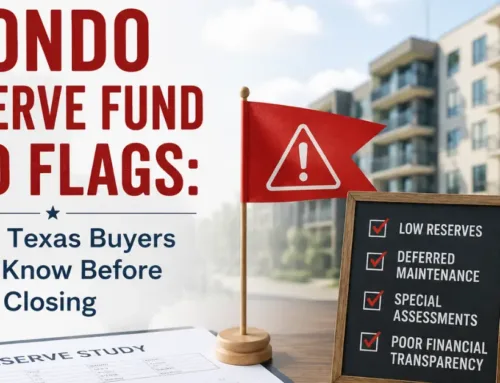
- Reserve fund balance: Compare the current balance against the reserve fund study to understand how funded the association actually is. A reserve funded below 50% deserves scrutiny.
- Reserve fund study: This document projects future repair and replacement costs for major components over a 20-30 year horizon. It’s the financial roadmap for the building. If the association doesn’t have one, that’s a problem in itself.
- Last two years of financial statements: Look for patterns – are expenses consistently over budget? Are reserves being depleted? Are there large line items that don’t repeat, suggesting one-time problems that may return?
- Any pending or recently levied special assessments: A special assessment is a charge levied on all owners when the reserve fund doesn’t cover a needed expense. These can run from a few hundred dollars to tens of thousands. Ask specifically: are there any pending, approved, or discussed special assessments?
Legal and Governance Records
- Current and pending litigation: Ask whether the association is a plaintiff or defendant in any active lawsuit. Litigation can affect insurance, financing eligibility, and your ability to sell the unit later.
- Meeting minutes from the last 24 months: Board minutes often reveal problems before they become official. Read them carefully for discussion of deferred maintenance, insurance disputes, vendor conflicts, or owner complaints that have been escalating.
- Declaration of covenants, conditions, and restrictions (CC&Rs): This is the governing document for the community. Know what you can and can’t do with the unit before you close – rental restrictions, pet policies, renovation approval requirements, and parking assignments are all typically addressed here.
- Bylaws and rules: Day-to-day operational policies. These fill in the gaps the CC&Rs don’t cover.
- Insurance certificate: Confirm the master policy covers the building envelope and common areas, and understand what it doesn’t cover (typically anything inside the unit walls). You’ll need your own HO-6 policy for interior contents and liability.
- Current delinquency rate: If more than 15% of units are delinquent on dues, lenders will often decline conventional financing – and it signals broader financial stress in the community.
Reading HOA documents is genuinely tedious work. But skipping it has consequences that can show up months or years after closing. The reserve fund study alone can tell you whether a $10,000 special assessment is likely in the next three years. That information is worth the time it takes to find it.
Section 3: Red Flags That Should Kill the Deal or Trigger Attorney Review
Not every problem is disqualifying. But some patterns should stop you completely, and others should send you directly to a real estate attorney before you proceed. Here’s how to distinguish them.
Deal-Stopping Red Flags
- Active litigation involving the building envelope or structural defects: These cases can drag on for years, affect insurance availability, and make the property nearly impossible to sell or refinance.
- Reserve fund below 30% funded with no corrective plan: This combination typically leads to special assessments or deferred maintenance – or both.
- Undisclosed special assessments that materially affect cost of ownership: If the seller failed to disclose a known pending assessment, that’s a legal issue, not just a negotiating point.
- Significant HOA fee delinquency rate (above 20%): At this level, the association may be unable to maintain services or fund repairs, and lender approval becomes very difficult.
- Evidence of active water intrusion in the building envelope: This is expensive to remediate and often recurrent. Without a clear repair plan and warranty, it’s a serious liability.
Situations That Require Attorney Review Before Closing
- Any undisclosed litigation or assessment discovered through document review (rather than seller disclosure): Why wasn’t it disclosed? That’s a question an attorney should help you answer.
- Unusual CC&R provisions: Rental restrictions that are unusually strict, assessment procedures that deviate from Texas law, or ambiguous language around repair responsibility
- Large pending capital projects without clear funding: A new roof approved but not yet funded is a financial exposure that needs to be priced into your offer or addressed in the contract.
- Prior construction defect claims or settlements: Even resolved litigation leaves a paper trail worth reviewing.
- Discrepancies between seller disclosures and HOA documents: When the two don’t match, someone isn’t being accurate – and you need to know which version to believe.
Section 4: What an Attorney Review Catches That Inspectors Miss
A licensed home inspector is trained to evaluate physical systems. They’re looking at what exists, what’s working, and what’s failing. That’s a specific and valuable skill set – but it stops at the walls.
A real estate attorney reviewing your condo purchase brings a different set of eyes entirely. Here’s where legal review adds real value that a physical inspection can’t replicate:
Contract and Disclosure Review
Your purchase agreement contains terms that could significantly affect your rights if problems surface after closing. An attorney can identify provisions that limit your remedies, improperly shift repair obligations, or waive rights you shouldn’t be waiving. Texas real estate contracts are standardized through TREC forms, but addenda and special provisions introduce room for terms that favor the seller.
HOA Document Analysis
Most buyers read HOA documents quickly or not at all. An attorney who works regularly in real estate transactions knows what to look for – the provisions that seem minor but carry real consequences, the inconsistencies between the CC&Rs and bylaws, the assessment procedures that deviate from Texas Property Code requirements. They can also spot when required disclosures are absent.
Litigation and Lien Review
Attorneys can run title searches and identify recorded liens, pending judgments, and litigation affecting the property or the association. Some of these issues won’t appear in seller disclosures – either because the seller doesn’t know, or because they’re omissions of convenience. Title work catches what disclosures don’t.
Special Assessment Risk Assessment
Reading a reserve fund study takes some financial literacy. An attorney with experience in condo transactions can analyze the gap between current reserve funding and anticipated capital needs, flag whether disclosed assessments are properly structured under Texas law, and advise on how to negotiate contingencies around future assessment risk.
Purchase Agreement Contingencies
If document review reveals problems, the right response is often negotiation – not walking away. An attorney can help you structure contingencies that give you exit rights, or negotiate price adjustments and seller credits that account for known issues. That requires understanding both the legal framework and the practical negotiating dynamics of your specific transaction.
Section 5: What the Texas Condominium Act Requires Sellers to Disclose
Texas has specific statutory requirements governing what condo sellers must provide buyers. The Texas Condominium Act (Texas Property Code, Chapter 82) and the Texas Uniform Condominium Act contain disclosure obligations that sellers of condominium units must satisfy as a condition of the transaction.
Under Texas law, a seller of a resale condominium unit is generally required to provide:
- A resale certificate: Prepared by the association, this document includes the current status of assessments, any pending or approved special assessments, the current reserve fund balance, any known pending litigation involving the association, and whether the unit is in compliance with the declaration
- A copy of the declaration and bylaws: The governing documents that define ownership rights and association obligations
- The most recent rules and regulations
- The current budget and financial statements
- A copy of the reserve fund study, if one has been completed
Texas law gives buyers a right to cancel the contract within a specified period after receiving the resale certificate and documents. This window is typically defined in the purchase contract. Miss it, and you may lose your ability to exit the transaction based on HOA-related concerns.
There’s an important practical point here: the resale certificate is only as reliable as the information the HOA provides. Associations with poor recordkeeping or governance issues may provide incomplete certificates. Pending litigation that hasn’t been formally disclosed to the association, or board decisions made informally without documentation, may not appear in the certificate at all. That’s why reviewing the meeting minutes yourself – rather than relying solely on the certificate – is valuable due diligence.
If a seller fails to provide required disclosures, or provides materially inaccurate disclosures, Texas law provides buyers with remedies. But those remedies are much easier to pursue if you identify the problem before closing rather than after.
Get a Pre-Purchase Condo Review Before You Close
Condo inspection isn’t just about the unit. It’s about understanding the organization you’re buying into – its financial health, its legal standing, and the obligations it can place on you after you own the unit. The physical inspection is one piece of that picture. The document review is another. And the legal analysis is what ties them together.
At Kelly Legal Group, we work with Austin-area condo buyers who want a clear picture of what they’re purchasing before they commit. We review purchase agreements, HOA governing documents, resale certificates, and financial records – and we advise on what we find, not just what’s been disclosed.
If you’re under contract on a condo in Austin or the surrounding area, or if you want to understand your rights before you get there, we’re available for a pre-purchase consultation. Learn more about our condominium law practice or contact us directly to schedule a review before you close.
Frequently Asked Questions About Condo Inspections in Austin
Do I need a separate inspection for a condo versus a house?
The physical inspection process is similar, but you’ll typically be inspecting only the interior of your unit and the systems that serve it. Shared systems and common areas may be inaccessible to your inspector. The bigger difference is the document review component – reviewing HOA financial records and governing documents is a step that simply doesn’t apply to single-family home purchases. Many buyers find it helpful to have a real estate attorney assist with document review even if they handle the physical inspection independently.
Can the HOA prevent me from renting my condo after I buy it?
Yes. Many Austin condo associations have rental restrictions, including outright bans on short-term rentals and caps on the percentage of units that can be leased at any given time. These restrictions are embedded in the CC&Rs and are legally enforceable. If rental income is part of your investment strategy, confirm the rental policies before you go under contract – not after. Review the CC&Rs carefully and confirm with the HOA directly.
What is a special assessment, and how much warning will I get?
A special assessment is a charge levied on unit owners when the HOA’s reserve fund doesn’t have sufficient money to cover an unexpected or planned expense. Special assessments can range from a few hundred dollars for minor repairs to tens of thousands for major projects like roof replacement or structural repairs. In some cases they can be paid in installments; in others, a lump sum is required. Texas law has some procedural requirements for how associations levy special assessments, but there’s no cap on the amount. The best protection is reviewing the reserve fund study and asking directly whether any assessments are under discussion.
What happens if I discover problems after closing that weren't disclosed?
Your options depend on the nature of the problem and what was disclosed – or should have been disclosed – before closing. Texas law provides remedies for fraudulent concealment and material misrepresentation. If the seller or the HOA provided materially inaccurate information in the resale certificate or disclosure documents, you may have a claim. Whether that claim is worth pursuing depends on the specifics. An attorney can evaluate the facts, advise on your remedies, and help you understand the realistic cost-benefit of pursuing relief versus absorbing the problem.
Should I hire a real estate attorney even if I have a realtor?
Realtors and real estate attorneys serve different functions in a condo transaction. Your realtor guides you through the market, negotiates on your behalf, and manages the transaction process. An attorney reviews the legal documents, identifies legal risks in the governing documents and contract, and advises on rights and remedies. These roles complement each other rather than substitute for one another. For a condo purchase – where the document review component carries real financial and legal risk – having an attorney review the HOA records and purchase agreement before you close is a sound investment.