There are questions to ask when buying a condo that most buyers never think to raise – and those are exactly the questions that protect you from the most expensive surprises in real estate. A condo purchase looks simple on paper: find a unit you love, your realtor pulls comps, you make an offer. But what most buyers don’t realize is that buying a condo comes loaded with legal layers that a single-family home never has. You’re buying into a legal entity, adopting its financial obligations, and agreeing to rules that can affect how you live in, rent out, or eventually sell your home.
I’ve reviewed enough condo transactions to know where buyers get hurt – and it’s almost never the obvious stuff. It’s the $40,000 special assessment that was already voted on before closing. It’s the association in litigation with the developer for two years. It’s the reserve fund sitting at 18% funded when it should be at 70%. These are the what to know before buying a condo questions that most people never raise until it’s too late.
This guide covers the legal due diligence questions every condo buyer should ask – and every realtor should know cold. Whether you’re the buyer or the professional guiding them, this is what separates a clean transaction from a costly mistake.
⚠️ The 3 Condo Surprises That Hurt Buyers Most
- Special assessments voted on before closing – but not yet collected or disclosed
- Severely underfunded reserve funds – signaling future large assessments
- Active association litigation – which can block financing and drain funds
Questions to Ask About the HOA and Condo Association
The association is the legal backbone of any condo community. Before you commit to a purchase, you need to understand its financial health, its legal history, and what obligations you’re inheriting the moment you close.
What is the current reserve fund balance, and what percentage is it funded?
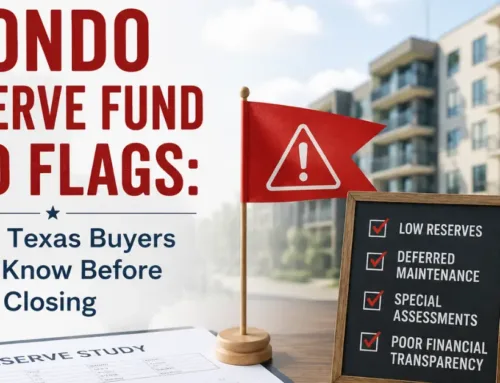
A reserve fund is the association’s savings account for major repairs – roofs, elevators, parking structures, HVAC systems. A healthy reserve is typically funded at 70% or above relative to the association’s reserve study. Below 50% is a warning sign. Below 30% is a serious problem.
Ask for a copy of the most recent reserve study. This document projects when major components will need replacement and how much it will cost. If the fund is severely underfunded, the association has two options: take out a loan or levy a special assessment against every unit owner. Either way, you pay. Know exactly what to look for in that study – including the specific numbers that signal serious risk – in our guide to condo reserve fund red flags.
Are there any pending or approved special assessments?
This is one of the most important questions to ask when buying a condo, and sellers don’t always volunteer the information. A special assessment is a one-time charge levied on all unit owners when the reserve fund can’t cover a necessary expense. Amounts can range from a few hundred dollars to tens of thousands per unit.
Ask specifically: Has any special assessment been voted on but not yet collected? Has the board discussed any upcoming major repairs at recent meetings? Review the last 12-24 months of meeting minutes – they’ll often reveal conversations about problems the seller hasn’t disclosed.
Is the association currently involved in any litigation?
Litigation can freeze financing options and signal deeper problems. Ask whether the association is suing or being sued – and by whom. Common scenarios include disputes with developers over construction defects, conflicts with individual unit owners, or fair housing complaints.
Some lenders will not approve financing for units in associations involved in active litigation. Even if your lender approves the loan, ongoing litigation drains association funds and can result in assessments against all owners if the association loses.
What are the current monthly dues, and have they increased in the past three years?
Rising dues are normal and often healthy – it means the association is keeping pace with costs. But a pattern of large, sudden increases can indicate mismanagement or deferred maintenance catching up with the community. Ask for three years of budget history and look for whether dues have kept pace with reserve contributions.
What percentage of units are owner-occupied versus rented?
This matters for two reasons. First, many conventional lenders require a minimum owner-occupancy ratio – typically 50-51% – before approving financing. Second, a high rental concentration can affect community stability, property values, and how well the association enforces its rules.
Reserve Fund Health: What the Numbers Mean
| Funding Level | Status | What It Means for Buyers |
|---|---|---|
| 70% or above | ✅ Healthy | Low risk – association is financially prepared |
| 50–69% | ⚠️ Caution | Review reserve study carefully; assess upcoming projects |
| 30–49% | 🔶 Warning | Special assessment risk is elevated – negotiate accordingly |
| Below 30% | 🚨 Serious Problem | High probability of large assessments; consult attorney before proceeding |
Questions to Ask About the Condo Documents
Every condo community operates under governing documents – the declaration (CC&Rs), the bylaws, and the rules and regulations. These documents define your rights as an owner, the association’s authority over your unit, and what you can and cannot do with your property. In Texas, sellers are required to provide these documents. That review period is your window to find problems. Don’t waste it.
What does the declaration say about ownership boundaries?
The declaration defines exactly what you own. Some condos are “air space” units – you own the interior space from the paint inward, and the association owns everything structural. This matters enormously when something breaks. If your HVAC unit is inside your walls but serves only your unit, is it your responsibility or the association’s? The answer determines who pays for a $10,000 replacement.
What restrictions apply to rentals, short-term rentals, and pets?
Many associations have strict rental caps – limiting the percentage of units that can be rented at any given time. If you plan to rent the unit now or in the future, confirm that rental slots are available. Short-term rental restrictions (Airbnb, VRBO) have become increasingly common and are often buried in the rules rather than the declaration. If short-term rental income is part of your financial plan, verify explicitly that the governing documents allow it.
What are the red flags to look for in the bylaws?
A few provisions deserve particular attention when reviewing condo documents:
- Board authority to levy assessments without member vote – gives the board significant unchecked power
- Vague or broad fine authority – associations with poorly defined enforcement powers can become difficult to live under
- Restrictions on owner input or meeting attendance – healthy associations welcome owner participation
- Right of first refusal provisions – the association may retain the right to purchase your unit before you sell to a third party
- Amendment procedures – if rules can be changed by a simple board vote, what you rely on today may be gone tomorrow
Are the governing documents current, and have there been recent amendments?
Ask for all amendments to the original declaration and bylaws. A community might have an original declaration from 1998 and five amendments made since then. The amendments control. If you only read the original document, you’re reading rules that may no longer apply.
Questions to Ask About the Physical Unit
The condo documents tell you about your legal environment. The physical inspection tells you about your actual home. In a condo, that inspection comes with complications that single-family homes don’t have – because your unit doesn’t exist in isolation.
What are your inspection rights, and what can you actually inspect?
Standard condo inspections focus on what’s inside your unit – appliances, electrical panels, plumbing fixtures, HVAC, and windows. But inspectors typically cannot access shared mechanical rooms, the building’s main electrical or plumbing systems, the roof, or common areas. A building can have serious deferred maintenance on systems affecting every unit – and your inspector will never see it. Before you close, work through a complete condo inspection checklist that covers both the physical unit and the legal and financial records – because the inspection alone won’t catch everything that matters
Who is responsible for shared systems that serve your unit?
This question trips up condo buyers constantly. Ask specifically about each of the following:
- HVAC systems – Is the unit owner responsible for repairs and replacement, or is this a shared system?
- Water heaters – Especially important in buildings with central hot water systems
- In-wall plumbing – If a pipe bursts inside your wall, who is responsible? What about water damage to the unit below?
- Windows and exterior doors – Often classified as common elements even though they’re within your unit’s boundaries
- Balconies and patios – Frequently classified as “limited common elements” with split maintenance responsibility
What is the defect history of the unit and the building?
Request the association’s records of any insurance claims, construction defect disputes, and significant repairs to the building in the past five to ten years. Review the meeting minutes carefully – boards discuss problems in meetings, and those minutes are a record of what the association knew and when. If recurring maintenance issues appear year after year without resolution, that’s what to know before buying a condo.
What does the master insurance policy cover?
Condo associations carry a master policy covering the building structure and common areas. But the scope varies significantly depending on whether the policy is “bare walls in,” “original spec,” or “all-in.” A bare walls policy leaves your fixtures, flooring, cabinets, and personal property entirely your responsibility. Understanding the gap between the master policy and your personal HO-6 policy determines how much individual insurance you’ll need to carry.
Condo vs. House: Why Due Diligence Is Different
| Due Diligence Area | Single-Family Home | Condo |
|---|---|---|
| Physical inspection | ✅ Full property | ⚠️ Unit only – shared systems inaccessible |
| Financial obligations | Mortgage + taxes only | + HOA dues + potential special assessments |
| Governing documents | None (or simple HOA) | Declaration, bylaws, amendments, rules |
| Rental/use restrictions | Minimal | Caps on rentals, STR rules, pet limits |
| Litigation exposure | Your property only | Association litigation affects your financing & finances |
| Attorney review recommended | Situational | Strongly recommended for all buyers |
When to Involve an Attorney Before Closing on a Condo
The question isn’t whether you should involve a real estate attorney in a condo purchase. For most buyers, the answer is yes. The question is when – and what role the attorney should play.
Document Review
Condo governing documents are legal contracts, and they’re often dense and written to protect the association rather than the buyer. Having an attorney review the declaration, bylaws, and all amendments before you close is one of the highest-value uses of legal counsel in a real estate transaction. An attorney can identify provisions affecting your ability to rent the unit, sell it in the future, or make improvements – plus flag unusual assessment authority or problematic amendment procedures your realtor may not have noticed.
Financial Red Flags
If the reserve fund is severely underfunded, if there are pending special assessments, or if the association has a history of financial mismanagement, an attorney can help you evaluate the risk and structure protections into your purchase agreement. This might include requiring the seller to escrow funds for pending assessments or making clear how an approved but uncollected assessment will be handled at closing.
Litigation Situations
If the association is involved in active litigation – particularly construction defect litigation – you need legal guidance before you proceed. Depending on the nature of the lawsuit, your lender may refuse to fund, or you may be assuming liability exposure that isn’t immediately visible in the transaction documents.
Contract Review and Negotiation
Real estate contracts in Texas are heavily standardized, but addenda, seller disclosures, and association-specific documents create significant variation in what you’re actually agreeing to. An attorney reviewing your contract is looking for issues that a realtor – who is not permitted to give legal advice – cannot flag. This is especially true in situations involving neighbor disputes disclosed during due diligence, unusual easements, or transactions where the seller is an estate, LLC, or investor.
Buying a Condo in Austin
Buying a condo in Austin comes with market-specific considerations worth understanding. Many Austin-area condo developments built during the boom years are now aging into significant capital expenditure cycles – reserve funds established when buildings were new are facing their first major replacement projects. According to the National Association of Realtors, condos represent a growing share of first-time buyer purchases in high-cost markets like Austin, making informed due diligence more important than ever.
Downtown Austin condos often come with commercial mixed-use associations, hotel condo arrangements, or investor-heavy ownership structures that require additional scrutiny. If you’re purchasing in a building with hotel or short-term rental elements, the governing structure is more complex than a standard residential association, and legal review is worth the investment.
✓ Condo Buyer’s Legal Due Diligence Checklist
- Request declaration, bylaws, and all amendments
- Review last 12-24 months of board meeting minutes
- Obtain current reserve study and funding percentage
- Ask about any approved or pending special assessments
- Confirm no active litigation involving the association
- Verify rental caps and short-term rental policy
- Clarify responsibility for HVAC, plumbing, windows, balconies
- Review master insurance policy type (bare walls vs. all-in)
- Confirm owner-occupancy ratio meets lender requirements
- Have an attorney review governing documents before closing
Frequently Asked Questions About Buying a Condo
What documents should I request when buying a condo?
At minimum, request the declaration (or master deed/CC&Rs), the bylaws, all amendments, the current rules and regulations, the most recent budget and financial statements, the most recent reserve study, the last 12-24 months of board meeting minutes, and information about any pending litigation or special assessments. In Texas, sellers are required to provide resale certificates containing much of this information, but reviewing the underlying documents directly gives you a more complete picture of what to know before buying a condo.
Can a special assessment be charged after I buy the condo?
Yes. Special assessments can be levied at any time the association determines that reserve funds are insufficient to cover a necessary expense. An assessment approved by the board before your closing date is generally the seller’s obligation – but the contract language matters. Future assessments levied after you take ownership become your responsibility. A severely underfunded reserve is a clear signal that assessments are more likely in your future, which is why the questions to ask when buying a condo about reserve health are so important.
What does a real estate attorney actually do in a condo transaction?
In a condo purchase, a real estate attorney can review governing documents to identify unfavorable provisions, interpret disclosure obligations, evaluate litigation risk, review and negotiate the purchase contract, assist with title review, and guide you through the closing process. An attorney is particularly valuable when the transaction involves financial red flags in the association, active litigation, or unusual contract terms. Unlike a realtor, an attorney can give you legal advice – and in a transaction with this much legal complexity, that distinction matters.
How are condo purchases different from buying a house?
Beyond the physical differences, a condo purchase involves becoming a member of a homeowners association with legal obligations and financial exposure that don’t exist in a single-family home purchase. You’re subject to the governing documents, the decisions of the board, and the financial condition of the association – none of which you control individually. Many buyers apply the same checklist they’d use for a house and miss the most important risk factors entirely. Understanding what to know before buying a condo means understanding the legal entity you’re joining, not just the property you’re purchasing.
Get Legal Guidance Before You Close on a Condo
The questions outlined here aren’t meant to scare you away from buying a condo in Austin or anywhere in Texas. They’re meant to make sure you’re buying the right one – with full knowledge of what you’re getting into.
Most condo purchases go smoothly. But the ones that don’t tend to involve the same predictable problems: undisclosed special assessments, underfunded reserves, governing documents with provisions the buyer never read, and association litigation nobody mentioned at the showing. These are discoverable with the right questions and the right review process.
If you’re in the due diligence period on a condo purchase and want a legal review of the governing documents, contract, or association financials, contact Kelly Legal Group for a consultation. Our condo law practice helps buyers in Austin and throughout Texas close with confidence – and avoid the surprises that come from skipping the legal fine print.