
Your pay app went in 45 days ago, and the owner still says the check is “in process.” Under the Texas Payment Act, that late money may already be earning interest. On most commercial jobs, you may also have the right to stop work 10 days after a written notice.
Texas gives unpaid contractors, subs, and suppliers more tools than people expect. Kelly Legal Group’s Austin construction law attorneys use those tools for contractors, subs, and suppliers owed money on Central Texas jobs.
The Texas Payment Act is shorthand for two statutes. Texas Property Code Chapter 28 governs private work, and Texas Government Code Chapter 2251 governs jobs for a city, county, school district, or state agency. (Insurance claim payment rules sit in Texas Insurance Code Chapter 542, a separate law this guide doesn’t cover.)
Disclaimer. This article is for educational and informational purposes only and does not constitute legal advice. The Texas Payment Act involves specific statutory deadlines and notice requirements that vary by project type and contract. Consult a licensed Texas construction attorney for guidance on your specific situation.
What Is the Texas Payment Act?
The Texas Payment Act sets deadlines for paying the people who build and supply construction work, and it adds interest once a deadline passes. The deadlines run down the payment chain, from the owner to the general contractor and then to each tier of subs and suppliers.
You can’t sign these rights away on most jobs. Under Texas Property Code § 28.006, an attempted waiver of Chapter 28 is void. (One exception applies to single-family homes, covered below.)
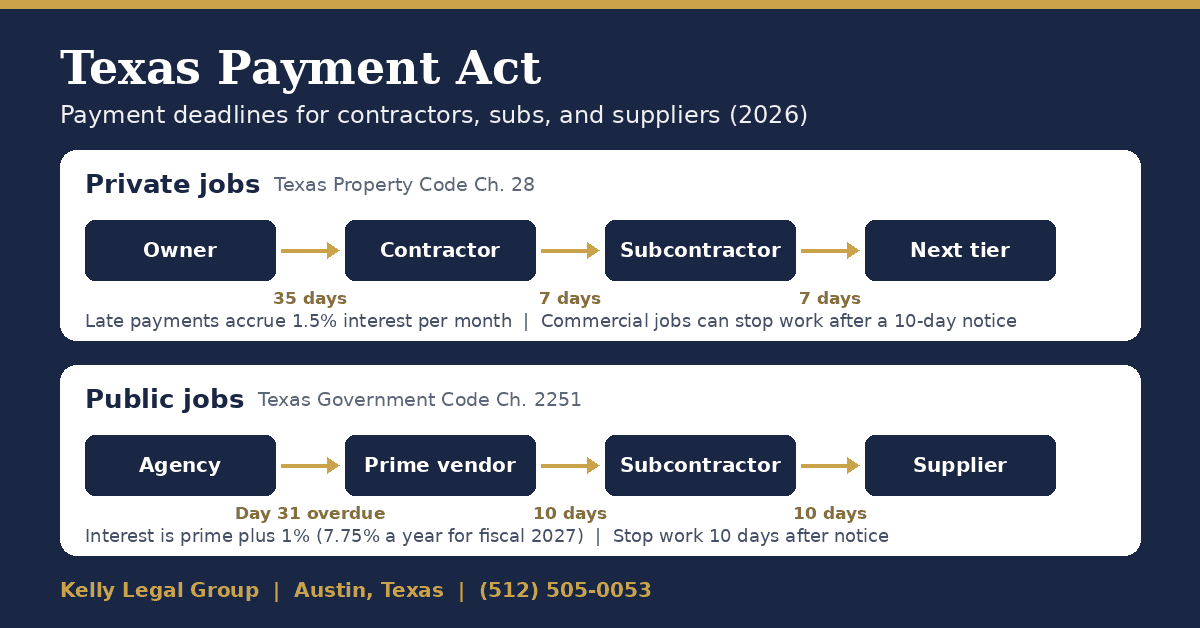
The table puts the private and public versions of the Texas Payment Act side by side.
| Rule | Private jobs | Public jobs |
|---|---|---|
| Statute | Texas Property Code Ch. 28 | Texas Government Code Ch. 2251 |
| Owner or agency deadline | 35 days after a written payment request | Overdue on day 31 after the latest of delivery, completion, or invoice |
| Contractor to sub | 7 days after the contractor is paid | 10 days after the vendor is paid |
| Interest on late money | 1.5% per month | Prime rate plus 1% (7.75% a year for fiscal 2027) |
| Right to stop work | 10 days after written notice (not on homes of one to four units) | 10 days after written notice |
| Attorney’s fees | Court may award them if equitable and just | Prevailing party recovers reasonable fees |
How Long Does a Contractor Have to Pay a Subcontractor in Texas?
The Texas Payment Act gives two answers. On a private job, the contractor has 7 days after it gets paid, and on a public job it has 10 days. The owner’s deadline sits one step above that, and it’s longer.
Private Jobs Under Texas Property Code Chapter 28
Under the private half of the Texas Payment Act, the owner has 35 days to pay after getting the contractor’s written payment request. (Tex. Prop. Code § 28.002(a).) That covers properly performed work and suitably stored materials, minus amounts the law lets the owner hold, such as retainage under Texas law.
Once the owner pays, the clock moves to the contractor. The contractor then has 7 days to pay each sub its share, including any interest the owner paid. (§ 28.002(b).) A sub that gets paid has the same 7 days to pay its own subs and suppliers.
Does the 7 days start when the owner releases the money or when the contractor has it? The statute runs it from the date the contractor receives the owner’s payment.
Two exceptions change the math. If the owner’s lender fails to fund a proper draw request, the owner’s deadline moves to the 5th day after the loan money arrives. (§ 28.008.)
A written contract on a single-family home can also push the owner’s deadline out to 60 days. (§ 28.006(b).)
Public Jobs Under the Texas Payment Act (Chapter 2251)
A payment from a government entity is overdue on the 31st day after the latest of these three dates.
- The day the entity receives the goods
- The day the work or service is complete
- The day the entity receives your invoice
(Tex. Gov’t Code § 2251.021(a).) A political subdivision whose board meets once a month or less gets until the 46th day. In the Austin area, that statute reaches work for the City of Austin, Travis County, Williamson County, and local school districts.
After the prime contractor (the statute calls it the vendor) gets paid, it has 10 days to pay each sub its share. The money is overdue on day 11. (§ 2251.022.) Subs then have 10 days to pay their own suppliers.
What Is the Texas Payment Act Interest Rate?
On private jobs, the Texas Payment Act rate is 1.5% a month. Interest starts the day after the payment was due and stops when payment is delivered. (Tex. Prop. Code § 28.004.) It also stops on the mailing date if the check arrives within 3 days, or when a court enters judgment.
Put numbers on it. An $80,000 progress payment that sits 60 days past due carries about $2,400 in statutory interest, or roughly $1,200 for each month late.
Public jobs use a lower rate that changes each year. Under § 2251.025, it equals the prime rate published in The Wall Street Journal on the first weekday of July, plus 1%.
The Texas Comptroller lists the rate at 7.75% for fiscal 2027, covering payments that go overdue from September 1, 2026, through August 31, 2027. (That’s an annual rate, so it builds slower than the private rate of 1.5% a month. Fiscal 2026 was 8.50%.)
Worried a lawyer will cost more than the invoice is worth? That’s a fair question on a thin-margin job. Kelly Legal Group offers a free consultation and talks through fees before you commit.
When Can a Contractor Legally Withhold Payment From a Sub?
The Texas Payment Act allows it only when there’s a good-faith dispute over the amount. Texas Property Code § 28.003 sets the rule, and a dispute over the quality of the work counts. (If the other side claims your work was defective, see how Texas handles contractor breach of contract disputes.)
The cap depends on the building. On a detached single-family home, duplex, triplex, or fourplex, the payer may hold back up to 110% of the difference between the two numbers. On other private projects, the cap is 100% of the difference.
Say you bill $50,000 and the general contractor says $42,000 is the right figure. On a commercial job, the GC can hold back $8,000 at most. It still owes the $42,000 on time.
Public jobs follow a similar rule. A government entity that finds an invoice error or disputes an amount must tell the vendor within 21 days after getting the invoice. (Tex. Gov’t Code § 2251.042.) It may hold back no more than 110% of the disputed amount.
What about a contractor not paying a subcontractor after the owner has already paid? Once 7 days pass after the owner’s payment, that GC is late and interest is running. A cash crunch on some other job doesn’t qualify as a good-faith dispute over your work.
How Do Texas Courts Read Pay If Paid vs Pay When Paid Clauses?
The Texas Payment Act sets the deadlines, and your subcontract can change when the clock starts. Two short phrases decide who carries the risk if the owner never pays.
| Clause | Typical wording | What it does in Texas |
|---|---|---|
| Pay when paid clause | “Contractor will pay Subcontractor within 7 days after Contractor is paid by Owner.” | Sets the timing. You’re still owed the money if the owner never pays. |
| Pay if paid clause | “Payment by Owner to Contractor is a condition precedent to Contractor’s duty to pay Subcontractor.” | Shifts the risk of owner nonpayment to you, within the limits of Chapter 56. |
A pay when paid clause is a timing rule. Texas courts don’t favor conditions precedent, and they tend to read unclear payment language as a promise to pay. (See Criswell v. European Crossroads Shopping Center, Ltd., 792 S.W.2d 945 (Tex. 1990).)
A pay if paid clause is different. Texas law calls it a contingent payment clause, and it makes the owner’s payment a condition of yours. (Tex. Bus. & Com. Code § 56.001.) Chapter 56 of the Business and Commerce Code puts real limits on it.
- The contractor can’t enforce it if the owner held back because the contractor failed to meet its own contract duties. (§ 56.051.)
- Once 45 days have passed since your written payment request, you can send written notice objecting to the clause. (§ 56.052.)
- That notice makes the clause unenforceable on the latest of the 10th day after the contractor gets it, the 8th day after Chapter 28 interest starts, or the 11th day after Chapter 2251 interest starts.
- A court can refuse to enforce it as unconscionable when the contractor didn’t check the owner’s ability to pay and share that in writing. (§ 56.054.)
- It can’t be used to knock out a valid mechanic’s lien. (§ 56.055.)
Chapter 56 sits outside the Texas Payment Act and works alongside it. It doesn’t reach every contract, though. It excludes design-only contracts, civil work such as roads, bridges, utilities, and water plants, and homes of one to four units. (§ 56.002.)
The contractor also has to raise the clause as an affirmative defense if you sue. (§ 56.056.)
When Can You Stop Work for Nonpayment in Texas?
On a private commercial job, the Texas Payment Act lets you suspend work 10 days after you give written notice. Under Texas Property Code § 28.009, the notice must state that you haven’t been paid and that you intend to suspend work for nonpayment.
The trigger is the owner’s failure to pay the contractor an undisputed amount on time. If the owner paid and only the GC is holding your money, look to your subcontract’s suspension clause instead.
It goes to the owner and, in some cases, the owner’s lender. The lender gets notice only when the owner has a construction loan secured by a recorded deed of trust.
The owner or lender must also have posted a job-site sign and mailed notices naming the lender within 10 days after work began. (Check the sign at the gate.)
You aren’t liable for suspension damages unless the owner told you in writing, before you stopped, that it paid or has a good-faith dispute. You also don’t have to come back until you’re paid, plus your demobilization and remobilization costs.
Two job types are carved out. The private suspension right doesn’t apply to homes of one to four units or to contracts with a government entity. (§ 28.009(e).)
Public work has its own version under the Texas Payment Act. A vendor on a government contract may suspend after a 10-day written notice with the same two statements. (Tex. Gov’t Code § 2251.051.) Section 2251.053 can set a later date on some contracts, so read it first.
What should you avoid? Walking off the job with no written notice. That move can hand the other side a breach claim.
Your contract may also add its own notice steps on top of the statute, so read the suspension clause before you send anything.
Texas added a related right in 2023. Under § 28.0091, you can decline owner-directed extra work without a signed change order once the unsigned extras top 10% of your original contract.
Who Pays the Attorney’s Fees Under the Texas Payment Act?
It depends on which half of the Texas Payment Act applies. In a Chapter 28 lawsuit, the court may award costs and reasonable attorney’s fees “as the court determines equitable and just.” (Tex. Prop. Code § 28.005.) That’s the judge’s call, and it isn’t automatic.
Chapter 2251 is stricter. In a formal action to collect an invoice or interest, the losing side pays the prevailing party’s reasonable attorney fees. (Tex. Gov’t Code § 2251.043.) That rule protects a vendor with a strong claim and can cost one with a weak claim.
Your contract may have its own fee clause, too. Texas Civil Practice and Remedies Code § 38.001 may also allow fees on a breach claim for labor, services, or materials. Kelly Legal Group’s contract dispute attorneys can tell you which fee path fits your claim.
What to Do When a Contractor Is Not Paying a Subcontractor (the First 30 Days)
Use this checklist to build a Texas Payment Act claim with a clean paper trail. Day counts run from the date your payment was due, so adjust them to your contract.
- Days 1 to 3. Pull the contract and find the payment terms, any pay if paid language, the notice address, and the suspension clause.
- Days 1 to 3. Ask the GC in writing if the owner has paid for your work. Email creates a dated record.
- Days 3 to 5. Send a written payment request that cites the right part of the Texas Payment Act (Chapter 28 or Chapter 2251), the amount due, and the interest now accruing.
- By day 7. Put every lien or bond notice deadline on your calendar. Texas lien notices follow their own monthly schedule, and our guide on how to put a lien on a property in Texas covers them.
- Days 7 to 10. If the job qualifies, send the 10-day suspension notice to the owner, plus the lender if required. Keep proof of delivery.
- Days 17 to 20. Decide if you’ll stop work once the notice period ends or keep working while you negotiate. Confirm your choice in writing.
- Days 20 to 30. Have an attorney send a demand letter that lays out the statute, the interest, and the fee exposure.
- Day 45 after your written request. If a pay if paid clause is in play, send the Chapter 56 objection notice. (This one falls outside the first month, so set the reminder now.)
A few mistakes cost subs more than the late payment itself.
- Signing an unconditional lien waiver before the money clears
- Relying on phone calls when the statute counts written notice
- Stopping work without the 10-day notice
- Letting a lien deadline slip while talks drag on
Jeff Kelly spent 15 years in the construction industry and later worked as a CFO before he practiced law. He reads a pay application with payroll, suppliers, and margin in mind. That background shapes how he weighs a claim’s cost against its value.
When Does a Texas Payment Act Claim Beat a Lien?
You rarely have to pick one. A statutory payment claim and a lien claim can run side by side, and on most private jobs they should.
A Texas Payment Act claim targets the party that owes you and adds interest (and sometimes fees). It’s often the faster pressure point when the owner has paid and the GC is sitting on the money. By then the 7-day deadline has already passed.
A lien targets the property itself. It carries more weight when the owner hasn’t paid or the GC may not be good for the debt. Lien filings have strict deadlines of their own, and our post on mechanic lien disputes covers how those fights play out.
On public jobs, you can’t lien public property. The public half of the Texas Payment Act and a payment bond claim under Government Code Chapter 2253 do that work instead. If the dispute is headed to court, our overview of construction litigation in Texas explains the process.
One caution. With a valid pay if paid clause and an owner who hasn’t paid, the lien may be your stronger tool. Section 56.055 protects lien rights.
Common Questions About the Texas Payment Act
What is the Texas Payment Act?
The Texas Payment Act is two state laws that set construction payment deadlines. Texas Property Code Chapter 28 covers private jobs, and Texas Government Code Chapter 2251 covers public ones. Late payments earn interest under each.
How long does a contractor have to pay a subcontractor?
Within 7 days after the contractor receives the owner’s payment on a private Texas job. (Tex. Prop. Code § 28.002.) On public work the deadline is 10 days, and the payment is overdue on day 11. (Tex. Gov’t Code § 2251.022.)
What happens if a contractor does not pay a subcontractor?
Interest starts under the Texas Payment Act. On a private job, the unpaid amount accrues 1.5% a month from the day after it was due. The sub may also be able to suspend work after a 10-day written notice, file a lien, or sue.
What should you do if a contractor does not pay a subcontractor?
Start with a written payment request that cites Chapter 28 or 2251 and the interest owed. Then calendar your lien or bond deadlines and send a 10-day suspension notice if the job allows it. Talk to a construction attorney before any deadline passes.
Can a contractor withhold payment to a subcontractor?
Only for a good-faith dispute over the amount owed, capped at the disputed difference. (On homes of one to four units, the cap is 110% of it.) A valid pay if paid clause can also delay payment, within the limits of Chapter 56.
Does the Texas Payment Act apply to home construction?
Chapter 28, the private half of the Texas Payment Act, covers residential work with two differences. A written contract on a single-family home can extend the owner’s deadline to 60 days. The suspension right also doesn’t apply to homes of one to four units.
Talk to a Construction Attorney Before the Next Payment Deadline Passes
A Texas Payment Act claim runs on deadlines, and each day an invoice sits unpaid, one of them gets closer. Owed money on an Austin or Central Texas job? Call Kelly Legal Group at (737) 257-6128 for a free consultation.
Bring the contract, your pay applications, and any emails about the payment. We’ll review the paper trail with you and explain which statute applies and what a claim would likely cost. The firm typically opens a new matter within 3 to 5 business days.
Prefer to write first? Use our contact form and include the job address and the amount you’re owed.
Still comparing firms? Our guide on how to choose a construction attorney in Austin lists the questions to ask.