
Choosing an LLC or Corporation in Texas
I’ll never forget the entrepreneur who walked into my office three years after forming his business. He’d chosen an LLC because someone told him it was “simpler.” Now he was trying to raise venture capital, and every investor was walking away. The problem? His business structure made it nearly impossible for them to invest.
He wasn’t stupid. He wasn’t careless. He just didn’t understand how one decision about LLC vs corporation in Texas would shape his entire business trajectory.
Here’s what keeps me up at night: I’ve watched dozens of Austin entrepreneurs make this same mistake. They treat entity selection like checking a box on a government form. They Google “LLC or corporation,” read a generic article written for businesses in California or New York, and make a decision that costs them thousands in the long run.
But Texas law is different. The tax implications are different. The growth strategies are different. And the consequences of choosing wrong? Those are very, very real.
The truth is, there’s no universal “best” choice between an LLC and a corporation. The right structure depends on what you’re building, how you plan to fund it, where you want to take it, and what you want your life to look like in five years.
I’ve helped hundreds of Texas business owners navigate this decision. I’ve seen LLCs work brilliantly for real estate investors and fail catastrophically for tech startups. I’ve watched corporations open doors for entrepreneurs seeking outside investment and create unnecessary tax burdens for solo consultants.
The difference between choosing right and choosing wrong isn’t just legal theory. It’s money, opportunity, and freedom.
Let me show you how to make this decision strategically.
What Most Texas Entrepreneurs Get Wrong About LLC vs Corporate Business Structures
Before we dive into the mechanics of LLCs versus corporations in Texas, let me clear up the myths that derail most entrepreneurs.
Myth 1: LLCs Are Always Simpler
I hear this constantly. “I want an LLC because it’s easier to manage.” And yes, LLCs offer more flexibility in how you structure management and distribution. But simple formation doesn’t mean simple operation.
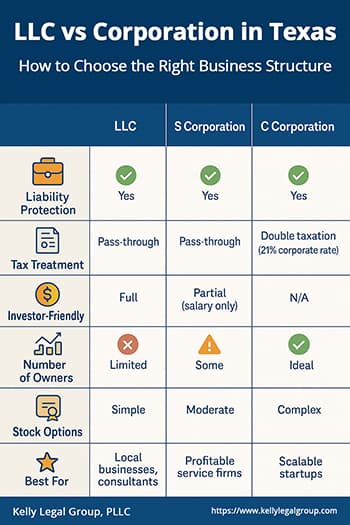
Here’s what people miss. If you’re planning to bring on investors, an LLC creates complexity that makes corporations look straightforward by comparison. Investors understand stock. They don’t want to deal with membership interests, capital accounts, and K-1 tax forms. I’ve seen promising startups struggle to raise capital simply because their LLC structure scared off sophisticated investors.
The reality? In the business of LLCs vs corporations, LLCs are simpler for some businesses and nightmares for others. It depends entirely on your specific situation.
Myth 2: Corporations Mean Double Taxation
This one drives me crazy because it’s only half true. Yes, C corporations face double taxation — the company pays corporate tax, and shareholders pay tax on dividends. But S corporations? They’re pass-through entities just like LLCs. The income flows through to your personal return.
And here’s something most articles won’t tell you: sometimes paying corporate tax actually saves you money. When you factor in self-employment tax, qualified business income deductions, and long-term planning, a C corp can be more tax-efficient than an LLC for certain Texas business owners.
When it comes to choosing an LLC vs a corporation, the blanket statement “corporations have worse taxes” is lazy advice that ignores how tax strategy actually works.
Myth 3: You Can’t Change Your Mind Later
People treat entity selection like a permanent tattoo. They agonize over the decision because they think they’re locked in forever. Not true.
Can you convert an LLC to a corporation? Absolutely. Can you switch from a C corp to an S corp? Yes, with proper planning. Are there tax consequences and procedural requirements? Of course. But the idea that you’re trapped in your initial choice paralyzes entrepreneurs who should just start.
I’d rather see you form the right entity for today with a plan to change as needed than spend six months overthinking it while your competitors are already operating.
The Real Question You Should Ask
Forget “which is better.” That’s like asking whether a truck or a sedan is better. Better for what? Hauling equipment? Commuting? Impressing clients?
The question that actually matters: “Which business structure in Texas aligns with my specific goals, funding strategy, tax situation, and growth plans?”
That’s what we’re about to figure out. And once you understand the real differences, this decision becomes a lot clearer.
How Texas LLCs Actually Work: The Complete Picture
When you are trying to determine which is better – an LLC or a corporation – let me walk you through what you’re really getting when you form a Texas limited liability company, starting with the fundamentals and building to the strategic implications.
Liability Protection: The Shield That Actually Works
An LLC creates a legal separation between you and your business. When structured and maintained properly, your personal assets — your home, your savings, your car — stay protected if the business faces lawsuits or debt.
I represented a client who owned rental properties through a Texas LLC. A tenant sued after a slip-and-fall accident. The lawsuit went after the LLC’s assets, but my client’s personal wealth remained untouched. That’s the shield working exactly as designed.
But here’s the critical detail most entrepreneurs miss: that protection only holds if you respect the separation. Commingling personal and business funds, failing to maintain proper records, or using the LLC as your personal piggy bank? That invites courts to “pierce the corporate veil” and come after your personal assets anyway.
The protection is real. But it requires discipline.
Tax Treatment: Pass-Through Simplicity With Hidden Complexity
By default, single-member LLCs are taxed as sole proprietorships, and multi-member LLCs are taxed as partnerships. This means pass-through taxation — the business doesn’t pay federal income tax. Instead, profits and losses flow through to your personal tax return.
For many Texas entrepreneurs, this is beautiful simplicity. Take a real estate investor I worked with who owns four rental properties. His LLC income passes through to his personal return. He pays income tax once, claims his deductions, and moves on. No corporate tax returns. No double taxation. Clean and straightforward.
But there’s a catch that surprises people: self-employment tax. As an LLC owner actively involved in the business, you typically pay self-employment tax (15.3%) on your business income. That’s Social Security and Medicare taxes hitting your entire profit.
Now, here’s where strategy matters. LLCs can elect to be taxed as S corporations, which lets you split income into salary and distributions. You pay self-employment tax only on the salary portion. For profitable businesses, this election can save thousands annually.
I helped an Austin consultant making 200,000 through his LLC elect S corp taxation. By paying himself a reasonable salary of $100,000 and taking $100,000 as distributions, he saved over $7,000 in self-employment taxes that first year alone.
The formation and Ongoing Costs of LLC vs Corporations in Texas
Let’s talk real numbers. Forming an LLC in Texas costs $300 for the Certificate of Formation filed with the Texas Secretary of State (fee schedule). You’ll also need a registered agent — someone with a physical Texas address to receive legal documents. That typically runs $100–300 annually if you use a service.
Texas doesn’t have state income tax, but it does impose a franchise tax on businesses with revenue over $2.47 million. For most small businesses, this means no franchise tax. But once you cross that threshold, you’re looking at 0.375% to 0.75% of your margin, depending on your business type. See the Texas Comptroller for thresholds and rates.
The ongoing requirements?
- File a Public Information Report every four years ($0 fee but required)
- Maintain an operating agreement even though Texas doesn’t require you to file it publicly
- Keep business finances completely separate from personal finances
Total annual cost for most small Texas LLCs: $100–500 beyond your regular business expenses.
Long-term Scalability: Where LLCs Shine and Struggle
Weighing LLCs vs corporations – LLCs excel for businesses that plan to operate profitably without seeking outside investment. Real estate investors, consultants, local service businesses, and family-owned operations often thrive as LLCs. The flexibility in profit distribution, the ability to adjust ownership percentages, and the pass-through taxation align perfectly with these models.
But if you’re building something designed for venture capital, angel investors, or an eventual acquisition by a larger company? LLCs create friction. Most investors want simple cap tables with common and preferred stock. They want clear, familiar equity structures. Explaining LLC membership interests and capital accounts adds complexity they’d rather avoid.
I watched a promising tech company in Austin struggle to close a $500,000 seed round because they formed as an LLC. Investors kept asking questions about tax treatment, dilution, and exit scenarios. Eventually, the founders converted to a C corporation — spending $3,000 in legal fees and three months of time they could have saved by choosing the right structure initially.
Understanding Texas Corporations: C Corps and S Corps Explained
Corporations operate under a completely different legal and tax framework than LLCs. Let me break down both types so you understand exactly what you’re choosing.
C Corporation: The Traditional Corporate Structure
When most people say “corporation,” they mean a C corporation. This is the default corporate structure — the same entity type used by Apple, Microsoft, and that coffee shop down the street seeking investors.
The liability protection mirrors an LLC. Shareholders aren’t personally liable for corporate debts or lawsuits. Your investment in the company is at risk, but your personal assets stay protected when you maintain proper corporate formalities.
Here’s where C corps diverge sharply from LLCs: taxation. The corporation pays federal corporate tax on its profits (currently 21%). Then, when you distribute those profits as dividends to shareholders, those shareholders pay personal income tax on the dividends. That’s the double taxation everyone warns you about.
So why would anyone choose this option – a corporation vs. an LLC in Texas? Let me show you the strategic reasons.
- First, C corps make raising capital straightforward. Investors understand stock. They can buy preferred shares with specific rights and preferences. They can participate in future funding rounds with clear dilution mechanics. The whole venture capital ecosystem is built around C corp structures.
- Second, C corps offer flexibility in ownership. You can have unlimited shareholders. You can issue different classes of stock with different voting rights and economic terms. You can grant stock options to employees as part of compensation packages. Try doing that cleanly with an LLC, and you’ll understand why tech companies incorporate.
- Third, and this surprises people, C corps can be tax-efficient for businesses retaining earnings. If you’re reinvesting profits into growth rather than distributing them to owners, you only pay corporate tax once. Compare that to pass-through entities where you pay personal income tax on profits whether you take the money out or not.
I worked with a manufacturing company in Austin planning significant equipment purchases. By operating as a C corp and retaining earnings for reinvestment, they paid 21% corporate tax instead of the owner’s 37% personal income tax rate. The savings funded their expansion.
S Corporation: The Hybrid Alternative
S corporations give you corporate structure with pass-through taxation. Think of it as a corporation that’s taxed like an LLC. The corporation itself doesn’t pay federal income tax. Instead, profits and losses flow through to shareholders’ personal returns.
But S corps come with restrictions:
- You can have no more than 100 shareholders
- All shareholders must be U.S. citizens or residents
- You can only issue one class of stock (though voting rights can differ)
- Certain types of businesses don’t qualify for S corp status
The big advantage over a regular LLC? Payroll tax savings. As an S corp shareholder-employee, you pay yourself a reasonable salary subject to payroll taxes, then take additional profits as distributions that avoid the 15.3% self-employment tax. See the IRS page on Form 2553.
Formation and Ongoing Requirements of a Corporation vs LLC
Forming a corporation in Texas means:
- Filing a Certificate of Formation with the Secretary of State ($300 fee)
- Appointing a registered agent
- Creating corporate bylaws
- Issuing stock to initial shareholders
- Holding an organizational meeting
Ongoing requirements include:
- Annual franchise tax reports to Texas
- Federal tax returns (1120 for C corps, 1120-S for S corps)
- Maintaining corporate records and minutes
- Holding regular director and shareholder meetings
- Keeping personal and corporate finances strictly separated
The administrative burden is real. Corporations require more formality than LLCs. But for businesses seeking investment, planning for acquisition, or offering employee equity, that structure is exactly what you need.
When Corporations vs. LLCs Make Strategic Sense
Choose a C corporation when:
- You’re seeking venture capital or angel investment
- Planning to go public eventually
- Want to offer employee stock options
- Expect to retain significant earnings for growth
- Need flexibility in ownership structure with multiple classes of stock
Choose an S corporation when:
- You want corporate structure with pass-through taxation
- Have 100 or fewer U.S. citizen shareholders
- Run a profitable service business where payroll tax savings matter
- Need simpler equity structures than C corps
- Want easier eventual conversion to C corp status if needed
LLC vs Corporation: Choosing the Right Business Structure for Your Texas Company
You’ve now seen how LLCs and corporations work in Texas. You understand the liability protection, tax implications, formation costs, and scalability considerations. Now comes the decision that shapes everything.
Here’s your framework.
Choose an LLC when:
- Your business generates income you’ll distribute to owners rather than retain for growth.
- You’re a real estate investor, consultant, or service provider operating locally without plans for outside investment.
- You value flexibility in management and profit distribution more than access to venture capital.
- You want simpler administration and fewer formalities.
- You’re a solo entrepreneur or small partnership focused on building sustainable income.
Choose an S Corporation when:
- You’re running a profitable service business where payroll tax savings justify the additional compliance.
- You want corporate structure but prefer pass-through taxation.
- Your business generates $75,000+ in annual profit where the salary-distribution split creates real savings.
- You have fewer than 100 shareholders who are all U.S. citizens or residents.
- You might eventually convert to a C corp but aren’t ready yet.
Choose a C Corporation when:
- You’re building something designed to scale rapidly with outside investment.
- You need to offer employee stock options as part of your compensation strategy.
- You’re planning to go public or be acquired by a larger company.
- You want flexibility in ownership with different classes of stock and potentially hundreds of shareholders.
- You’re retaining significant earnings for growth and reinvestment.
The Decision Timeline Matters
Here’s what I tell every entrepreneur I work with: making the wrong choice costs you, but making no choice costs you more. Analysis paralysis keeps you operating as a sole proprietorship — the worst possible structure for liability protection.
Start with what makes sense today while planning for tomorrow. You can convert entities as your business changes. Yes, there are costs and procedural requirements. But those pale compared to the opportunity cost of waiting to launch your business.
How Kelly Legal Group Guides Texas Business Formation
At Kelly Legal Group, we don’t just file formation documents. We help Austin and Central Texas entrepreneurs make strategic entity choices that align with their business goals, funding plans, tax situations, and growth strategies.
We start by understanding your specific situation. What industry are you in? How do you plan to fund operations? What does success look like in three years? Five years? Then we walk you through the practical implications of each structure for your circumstances.
We handle the formation process, make certain you meet all Texas requirements, create operating agreements or corporate bylaws that protect your interests, and set you up for compliant operation from day one.
One year from now, you’ll either be grateful you chose the right structure or frustrated you didn’t get proper guidance. The difference between those outcomes is making this decision strategically instead of guessing.
If you’re starting a business in Texas, or if you’re questioning whether your current structure still serves you, contact Kelly Legal Group. We’ll assess your situation, explain your options clearly, and help you choose the entity structure that positions you for success. You can also browse more insights on our legal blog.
Don’t let entity selection become the decision that limits everything you build. Get it right from the start.

Jeff Kelly is the founding attorney of Kelly Legal Group in Austin, Texas. He advises entrepreneurs and closely held companies on partnership dispute Texas matters, contract strategy, and risk management, with a focus on business breakup mediation Texas, arbitration, and structured buyouts. Jeff has guided hundreds of Central Texas businesses to resolve conflicts efficiently and avoid costly litigation. Schedule a consultation.
Frequently Asked Questions
What’s the main difference between an LLC and a corporation in Texas?
A Texas LLC offers flexibility in management and pass-through taxation, while a corporation (C or S) provides a more formal structure, preferred by investors, and can offer stock options. The right choice depends on your goals, funding plans, and tax situation.
Yes. Both entities provide liability protection, meaning your personal assets are generally shielded from business debts or lawsuits—so long as you maintain proper separation between business and personal finances.
Not always. Only C corporations face double taxation (at both the corporate and shareholder level). S corporations, like LLCs, are pass-through entities—profits and losses flow directly to owners’ personal tax returns.
Both LLCs and corporations require a $300 filing fee with the Texas Secretary of State. You’ll also need a registered agent (typically $100–$300 per year) and may owe franchise taxes once annual revenue exceeds $2.47 million.
Corporations—especially C corporations—are typically preferred by venture capitalists and angel investors because they understand stock-based ownership and find corporate equity structures more straightforward than LLC membership interests.
Yes. You can convert an LLC to a corporation or vice versa, though the process involves specific legal and tax steps. It’s far better to start with a structure that fits your short-term goals and plan for conversion as your business grows.
An S corp allows owners to pay themselves a reasonable salary (subject to payroll taxes) and take additional profits as distributions that aren’t subject to self-employment tax—often saving thousands annually in payroll taxes.
A Texas LLC is ideal for consultants, small service providers, or real estate investors who want flexibility, simple management, and pass-through taxation without the complexity of corporate formalities.
C corps are best for startups planning to raise outside capital, issue stock options, go public, or reinvest profits into growth. They also allow multiple classes of stock and unlimited shareholders.
Kelly Legal Group assists Texas entrepreneurs in choosing and forming the entity that best aligns with their goals, ensuring compliance, proper documentation, and long-term scalability from the start.